
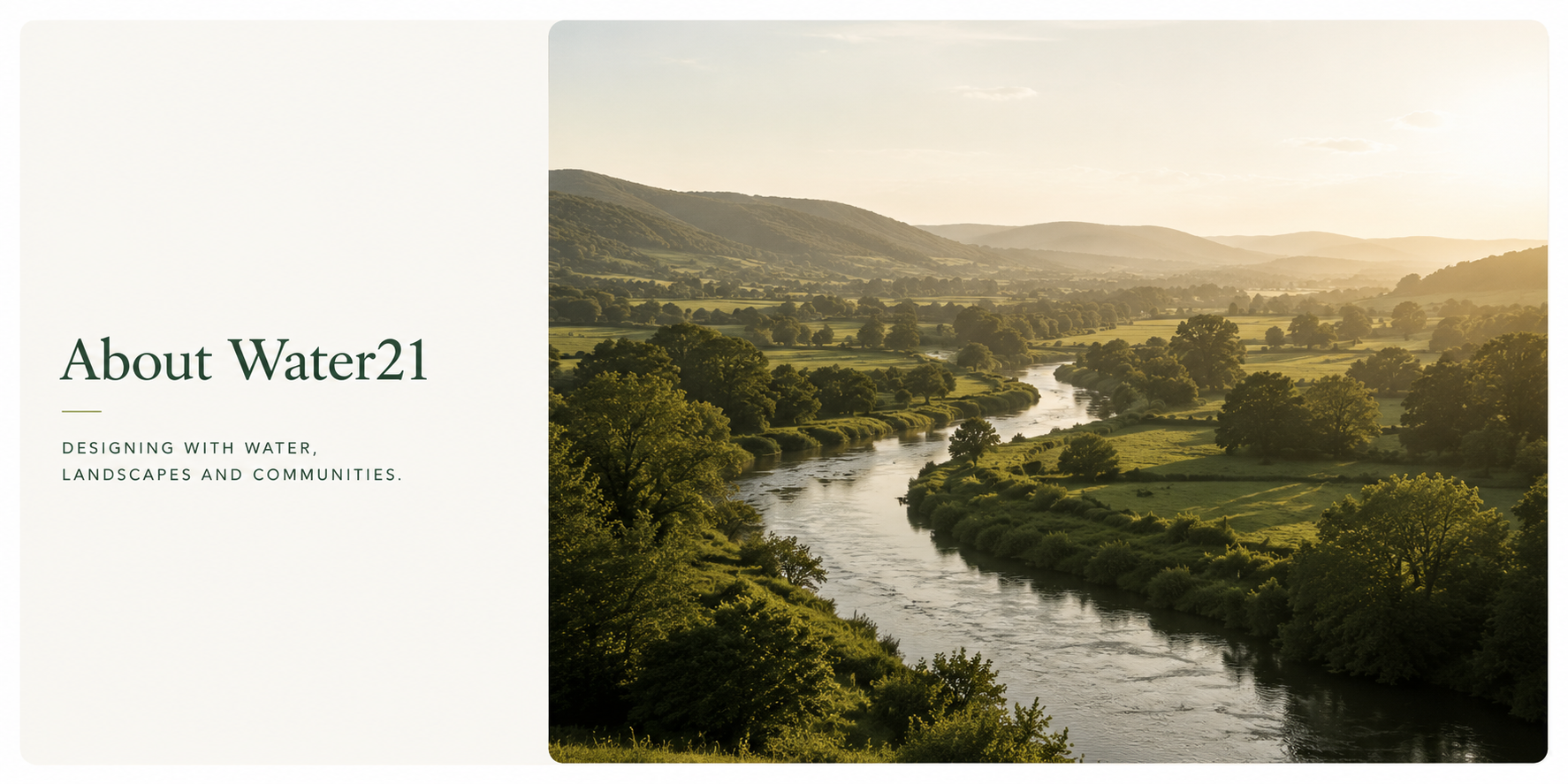
What Water21 Is
Water21 is an independent initiative exploring how water shapes landscapes, infrastructure and communities. It arose from a small collective of concerned engineers during 1980’s and was formalised under the Agenda 21 community-driven sustainable development process agreed at the 1992 Rio Earth Summit.
Article 14 of the Water Framework Directive makes such broad community consultation statutory.
Problems We See
Today many environmental debates are dominated by urgency, headlines and fragmented policy responses.
Flooding, drought, sewage pollution and biodiversity loss are often treated as separate crises. In reality they are symptoms of the same systems failure — the loss of a cohesive, community led landscape approach to water.
Our Approach
Designing landscapes that store water and rebuild soil.
Working with natural processes
using wetlands, soil carbon and hydrology as infrastructure.
Long-term resilience.
Creating systems that resolve ecosystems, agriculture and communities.
The Work
Our work brings together inter-generational knowledges, engineering, landscape design and systems thinking to understand how water actually moves through land — and how modern infrastructure can work with those natural processes rather than against them.
Foundations of Water21
Built on decades of practical work across water, land & infrastructure systems.
Early Work
The work began during 1970’s studying problems in local rivers. By the 1980’s applying lessons where feasible for many irrigation, waste & water engineering projects.
There was a consistent pattern: water systems were being managed in fragments, despite operating as a whole.
A Key Realisation
Flooding, drought and water quality were not separate challenges.
They were connected outcomes of how landscapes were designed and managed.
This shifted the focus from individual problems to systemic behaviour.
Working Against the System
Attempts to implement integrated approaches often encountered structural barriers.
Governance, regulation and funding were not aligned with how water actually moves.
This tension became a defining part of the work from 1984.
From Projects to Framework
Over time, individual projects evolved into a broader systems approaches.
Water21 brings this experience together as a coherent framework —
aligning infrastructure, land and water at the scale of the landscape.
Meet our Founders

Osman Goring
A leading pioneer in the rediscovery of lost small hydropower. Maintained a strong vigilance for the natural and river environments. Made many important interventions.

Julian Jones
Co-founded Water21 and has over 30 years’ experience designing landscape-scale water systems that integrate flood, drought and water quality. A pioneer of SuDS, CaBA, NFM and Regenerative Farming in the UK. Distinguished Fellow at The Schumacher Institute, Hon. Gloucestershire NHS.

Dr Lucian Gill
Is the leading pioneer in advanced Phytoremediation systems, capable of cleaning highly polluted water. Working closely with Water21, his plant-based technologies have been applied at scale, including major industrial systems worldwide.

Richard Maisey
Co founding Director of Water21. Very active social campaigner, particularly for climate. Stroud District Councillor.

Sue Coppard
Co-founded Water21 in 1997, to formalise already ongoing work. Alongside founding WWOOF, the global movement connecting people with organic farms, her work centres on reconnecting people, land and living systems — a perspective that continues to shape Water21’s approach.

Harry Tomlin
Whose clear vision provided the cornerstone and foundation for all Water21 work.
Harry explained working with natural processes required a different ethos to that which prevailed in society. Simply to be ‘in service’, as he put it, “because that is how nature works”.
He proposed constructed wetlands as an effective low cost solution to sewage pollution during the 1970’s. Also the vital importance of using river power on modified watercourses as the best and most economic means of improving rivers.

Bill Blake
Senior Pollution Control Officer for Seven Trent Water Authority, National Rivers Authority and Environment Agency. Fought many important legal cases to protect rivers.
Water defines how landscapes function.
When we understand that relationship, we begin to design systems that work with the living world rather than against it.
