
Farming – Overview
Healthy soil is a foundation of healthy water & our economy.
Modern agriculture is often expected to produce more while working with less—less water, fewer nutrients and increasingly unpredictable weather and is in crisis.
At the same time, flooding, drought, declining soil health and water pollution are frequently treated as separate challenges. In reality they are all symptoms of the same broken landscape system.
Water21 works with farmers, estates and communities to restore the natural movement of water through farmland. By rebuilding healthy soils, slowing runoff and increasing water storage within the landscape, farms become more productive, more resolved and better able to support biodiversity and community wellbeing.
The result is not simply better farming. It is healthier catchments, stronger rural economies and landscapes that continue to produce food and energy while supporting people, wildlife and future generations.
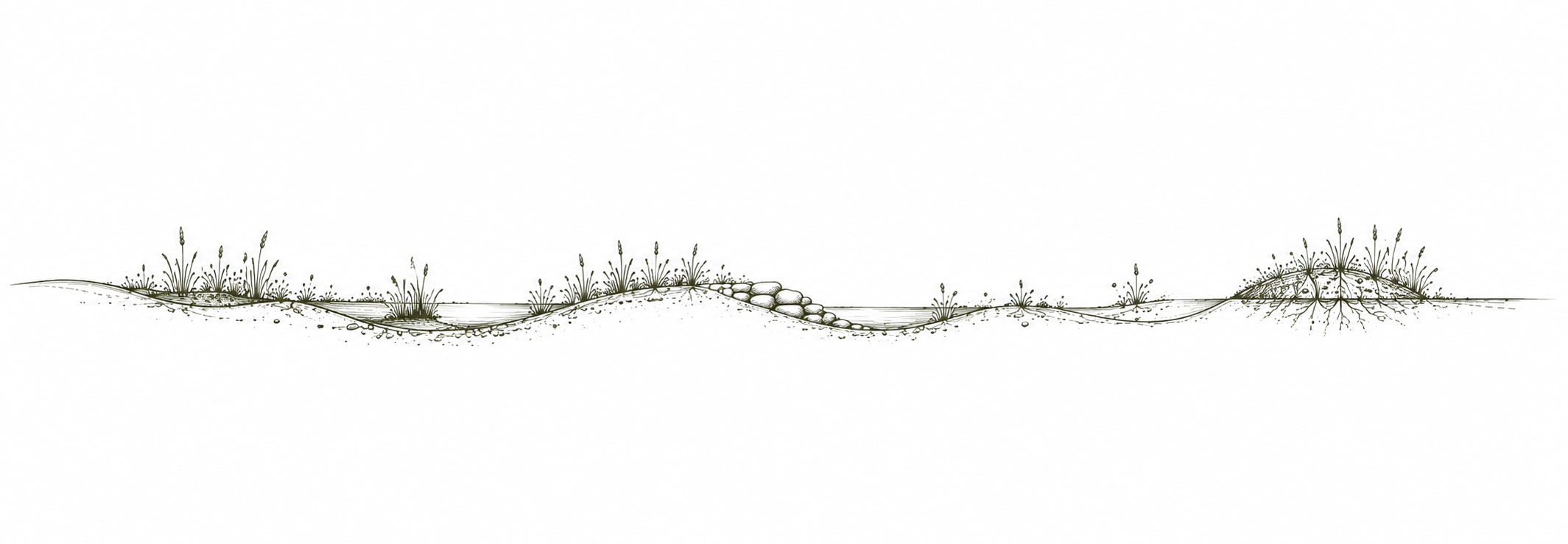
Every productive landscape follows the same natural cycle. Water is slowed, stored, filtered and reused through healthy soils, crops and wetlands.
When these natural processes work together, farming becomes more productive while supporting biodiversity, renewable energy & healthier communities.
The illustrations below show how integrated landscape design can create lasting value for both people and nature.


Regeneration
Australia | 2009
In 2009, Water21 co-produced Regeneration for Lifeworks Global; a documentary exploring how restoring natural water cycles can regenerate soils, farms and entire landscapes.
Filmed across Australia, this documented pioneering farmers demonstrating that flood, drought, soil health and biodiversity are interconnected. Many of the principles explored— Soil Carbon Sequestration, landscape-scale water management and regenerative farming—have since become central to global discussions on climate resolution.
Dawn to Dusk
United Kingdom | 2015
Produced by Water21 for the Biodynamic Association, Dawn to Dusk follows a day on a community-supported farm, exploring how healthy soils, water and people are fundamentally connected.
Filmed through the rhythm of a working farm, the documentary highlights regenerative agriculture, biodiversity and the vital role of near-zero input farming in restoring landscape function.


Water on Your Farm – Asset or Liability?
Oxford Real Farming Conference | 2015
In this conference presentation, Julian Jones explores how water can become one of a farm’s greatest assets. Drawing on decades of engineering and field experience, he explains how restoring natural water movement through the landscape can reduce flood risk, improve soil health and increase long-term agricultural productivity.
The lecture presents a systems approach to farming, demonstrating that water, soil and food production are fundamentally interconnected.
Stroud Valleys Soil Erosion Map
Working with Cranfield University and the Environment Agency, Water21 mapped soil-erosion risk across the Stroud Valleys. The study identified significant hotspots in the Painswick and Ruscombe catchments and explored how nutrient-rich river silt could be safely recovered and reused to improve agricultural soils—keeping valuable soil and nutrients within the landscape rather than allowing them to become a downstream pollution problem.
The effects of agrochemicals on soils – the biggest cause of raised temperatures, biodiversity loss, floods & drought.

Who We Recommend